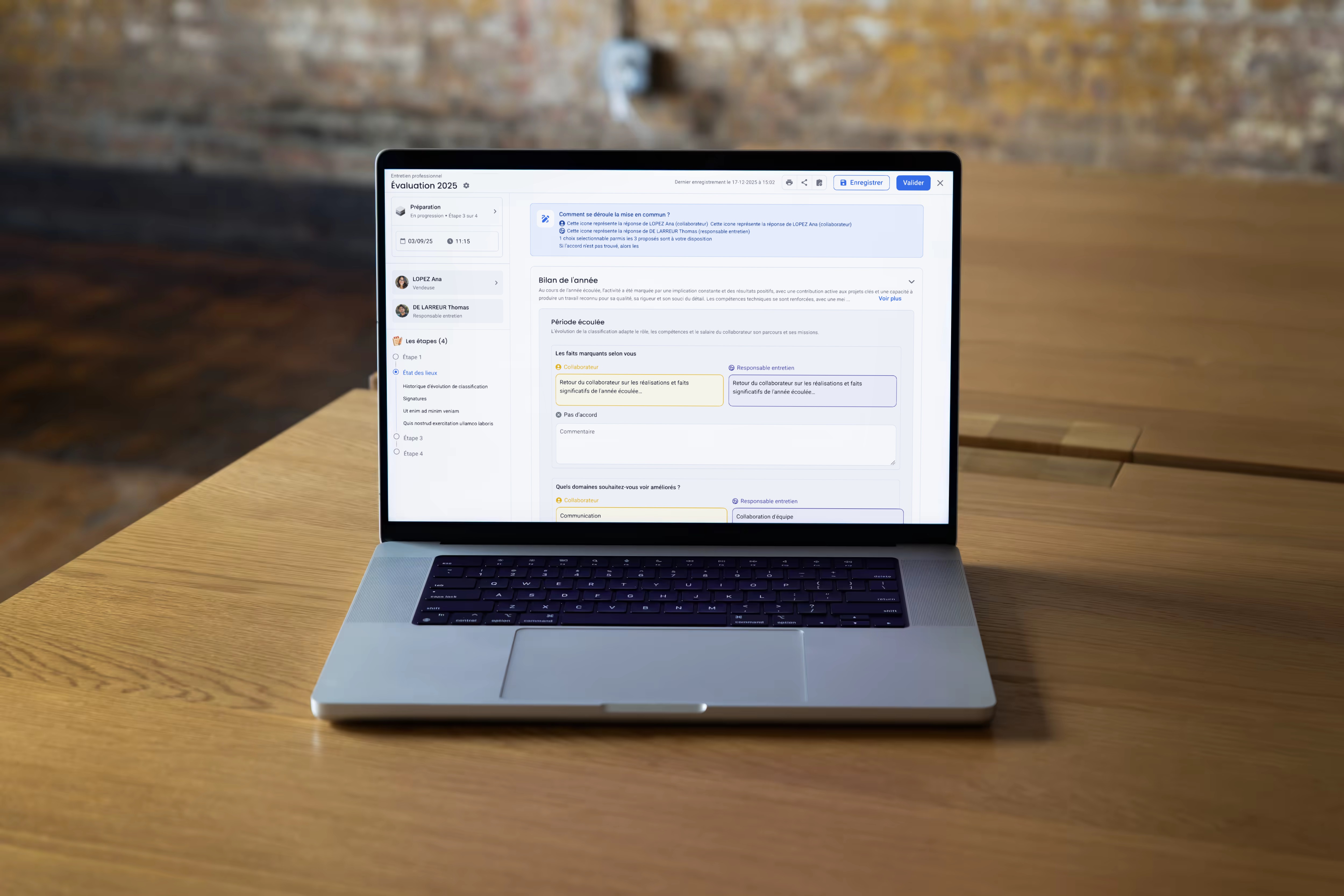
Overview
Annual reviews are a key moment for managers and employees, but the process was fragmented and not very collaborative.
Working completely independently (POM), I designed an end-to-end experience for preparing to sign: transparent exchange, fairness preserved, traceability guaranteed.
Currently in development after validation with 13 clients.
1 - Context & Challenge
The quarksUp interview module existed, but it was broken:
an incomprehensible interface, recurring bugs, and a flawed experience.
What should have been a key moment in professional development turned into an administrative chore.
Managers: confusing interface, no traceability, inefficient preparation.
Employees: deep frustration their responses didn't really matter. Managers systematically “remixed” their contributions, creating an imbalance in a process that was supposed to be collaborative.The opportunity: completely redesign this underperforming module.
Objectives:
Modern and intuitive interface
AI integration to facilitate writing and summarizing
Time tracking system
2 - Research & Discovery
The opportunity: completely overhaul this underperforming module. To validate the problem and guide the redesign, I conducted 13 video interviews with clients: 6 managers, 2 employees, 4 HR managers, and 1 partner.
3 key insights:
1. Collaboration is forced, not facilitated.
The system systematically overrode employee input. The history of disagreements disappeared, creating an imposed consensus without memory.2. Operational risks cause anxiety
No auto-save and dysfunctional signature → frequent data loss. Direct impact on premiums and legal compliance.3. Data exploitation is virtually impossible
Despite a wealth of raw information, no summary is available. Excel exports are unmanageable, dashboards are not very actionable.
Iterative process:
3 - User journey
A 4-step key process, designed to balance autonomy and collaboration.
Dashboard → Follow-up on discussions by stakeholder
Individual preparation → Independent reflection (personal + shared blocks)
Joint review → Simultaneous disclosure + synchronous alignment
Signature → Final validation (or rejection if disagreement persists)

4 - Design & Solution
Principle: create a shared space where managers and employees prepare in parallel, then meet to collaborate.
The interview is neither a simple managerial exchange nor an administrative form. It is the basis for decisions on objectives, training, job changes, and HR decisions.
4 pillars :
Autonomy : individual isolated preparation for free reflection
Collaboration : synchronous pooling to align point of views
Fairness : equal influence for both parties, right of refusal preserved
Traceability : complete history, auto-save, legal security
Objective: to express oneself honestly, without losing sight of the historical context, and to ensure that decisions have a real impact.
A - Dashboard
The responsible interview dashboard allows you to quickly manage and analyze all of your team's interviews. A grid view displays employees, interview type, date, progress, and status. KPIs provide an overview. Available actions: reschedule, delegate, filter. Employees have a simplified dashboard to track their own interviews.
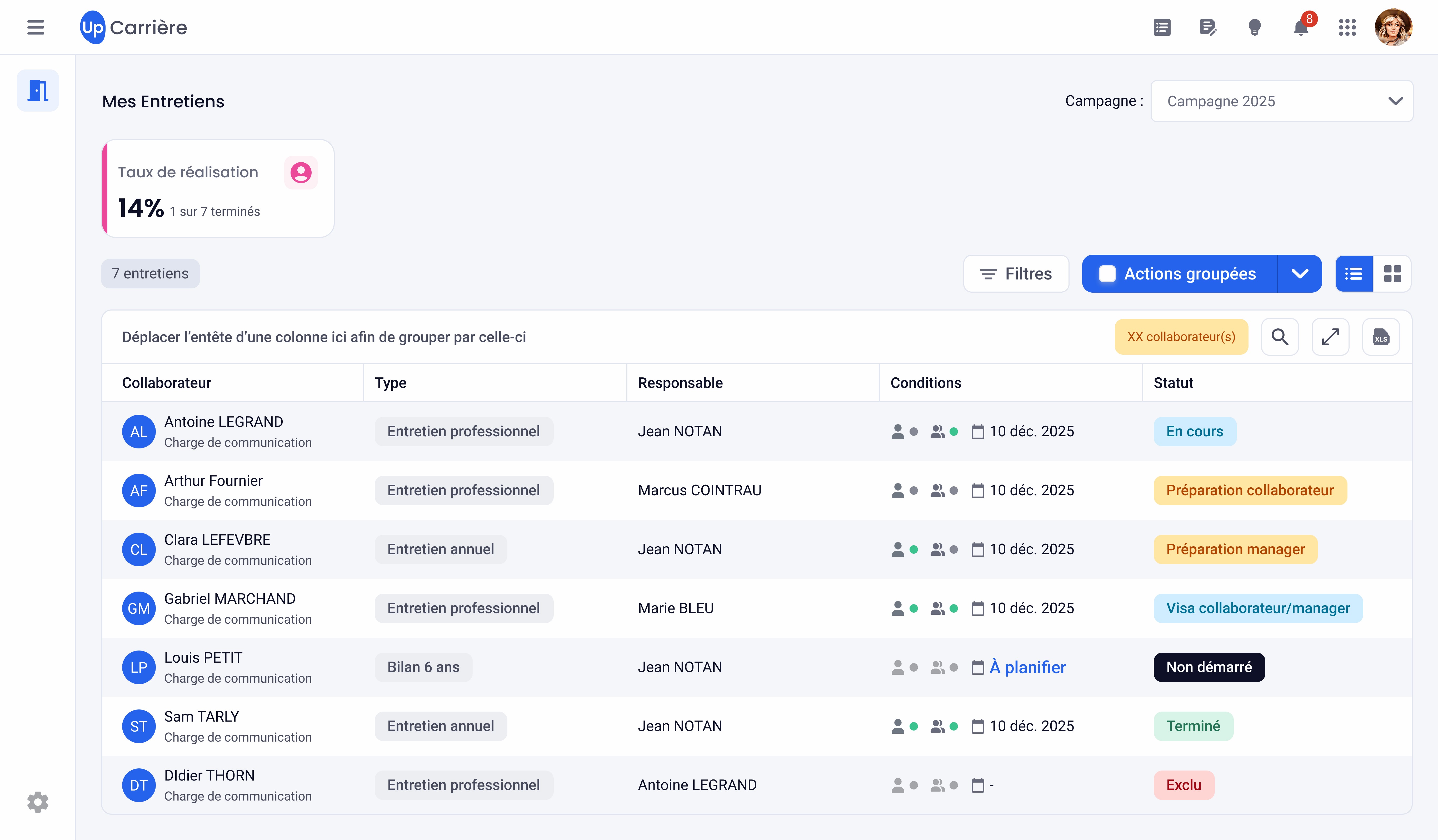
The Dashboard provides a clear overview with KPIs at the top, a structured grid, and quick actions (filters, delegation). Managers can manage effectively without wasting time.
B - Individual preparation
The critical moment: each participant reflects freely, without influence or self-censorship.
To ensure authenticity, the employee and manager do not see what the other has written before pooling their thoughts.
The challenge: a guided but flexible experience. Secure data (auto-save, real-time validation). Visually differentiate between personal (confidential) blocks and shared (co-contribution) blocks.
The video shows the entire preparation process:
Overview: sections organized progressively, auto-save enabled
Customized form: each user only sees the sections according to their access rights
C - Joint Review
The moment of truth: both preparations are revealed simultaneously.
The challenge: transforming a potential confrontation into a constructive dialogue. Creating the conditions for balanced and transparent exchange..
The goal : displaying two viewpoints without visual confusion. Managing disagreements constructively, no forced consensus.
The solution :
Merged interface with vertical split (Manager | Employee) + differentiation icons.
This is when the badge system appears: "Employee" and "Interview Manager".
For each question, 3 choices:
A : employee's answer
B : Manager's answer
C : Block disagreement (red border, colored background, icon) Both parties can edit in real-time and co-build the final version.
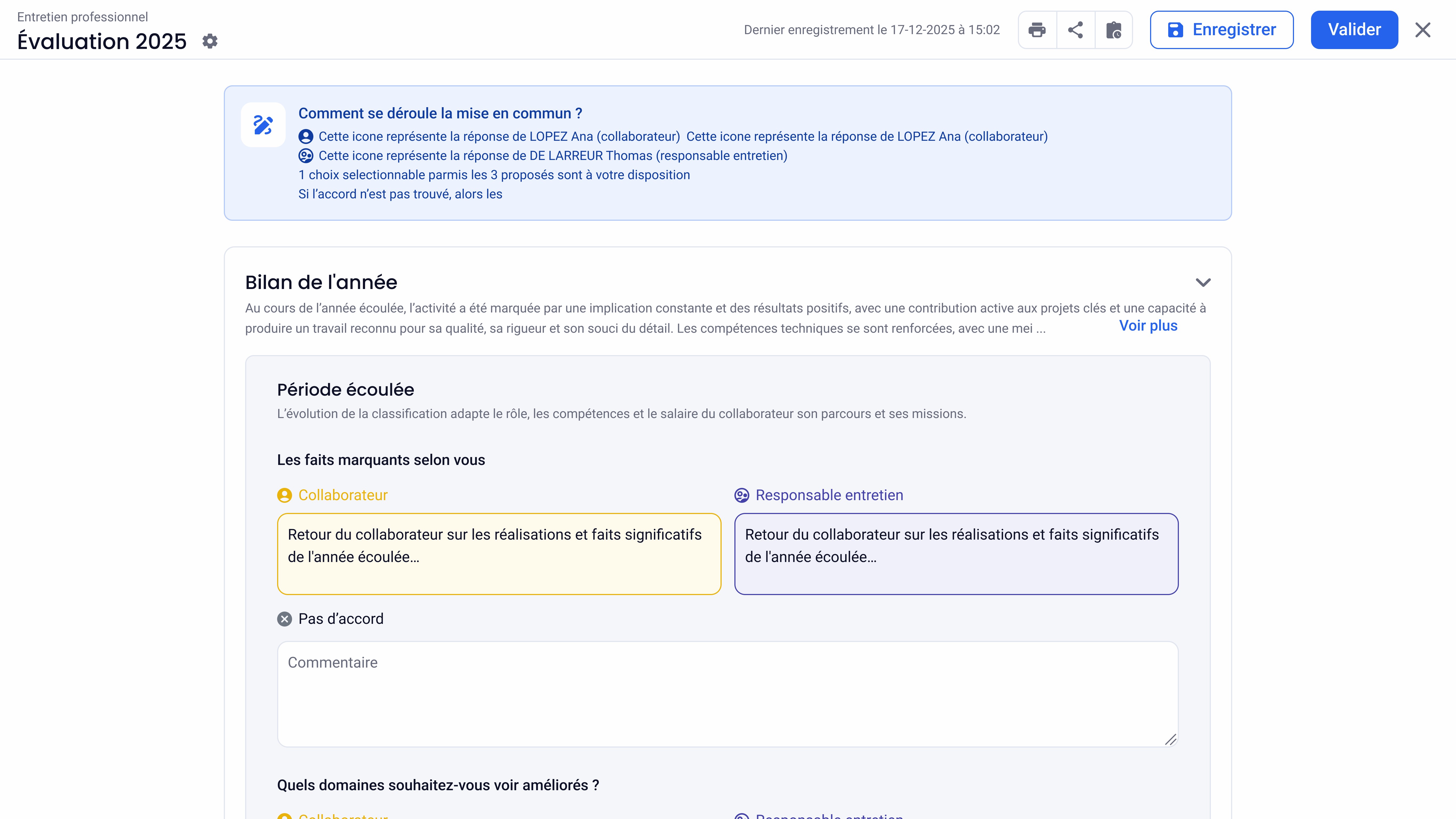
Both parties can edit in real-time and co-build the final version.
D - Signature
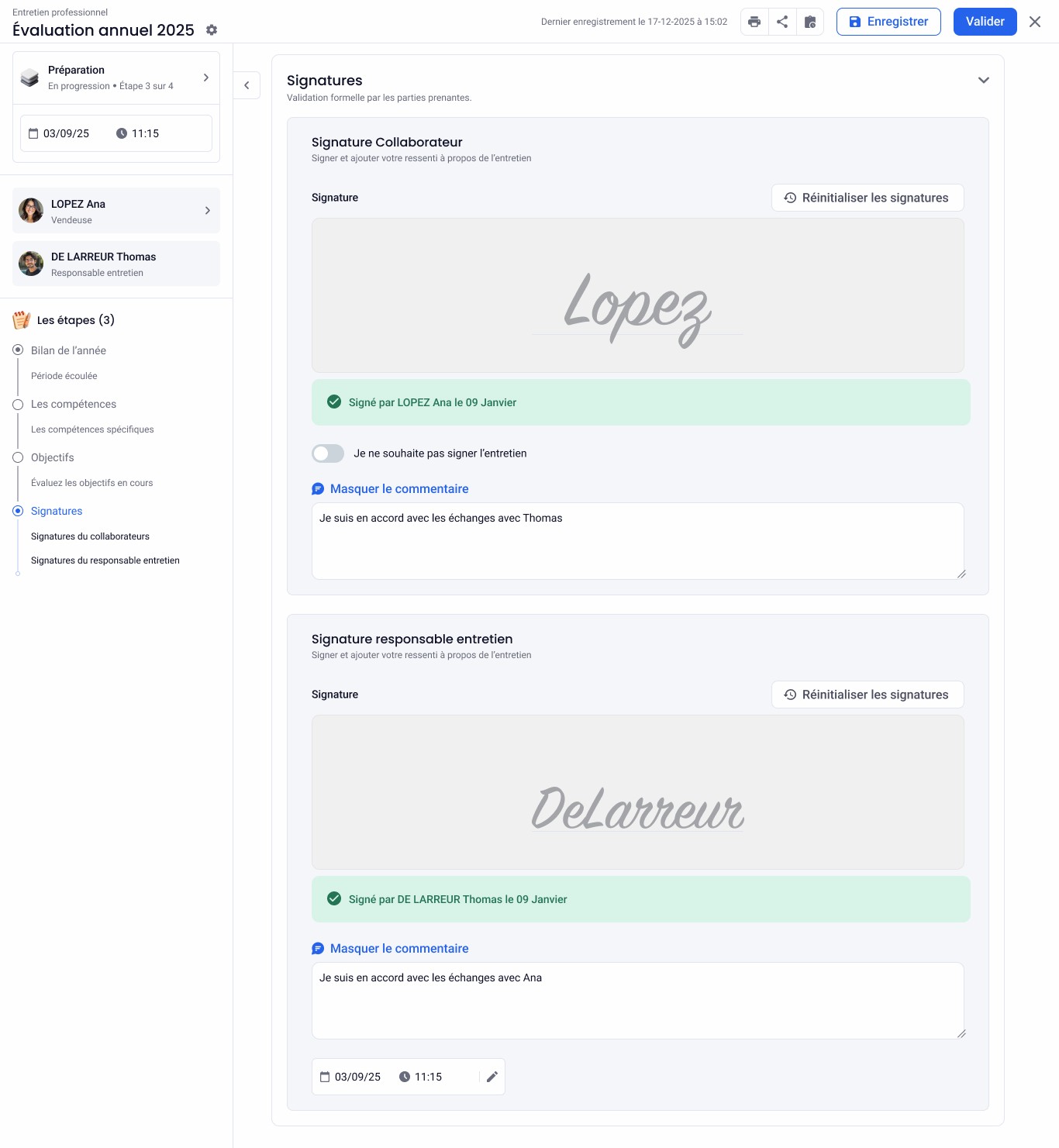
The signature finalizes the interview and commits both parties..
Preserved fairness: the employee has a toggle "I do not wish to sign the interview" to refuse if a disagreement persists.
Once signed (or refused), the action is timestamped to ensure legal traceability.
6 - Learnings
Designing for two personas with sometimes conflicting needs
Manager and employee have different expectations for the same process. I learned to create symmetrical yet adapted experiences, ensuring fairness without rigidity.
Always maintain complete control over the entire cycle independently POM
Working solo over half a years allowed me to own the project end-to-end: user research, design, client validation, developer handoff, continuous iterations.
Micro-details build trust in collaboration
In collaborative interfaces, every detail counts: how a disagreement is flagged, the order in which information is revealed, preserving the right to refuse. These micro-decisions build trust between stakeholders..
Prioritize based on business constraints
The demand for “mobile devices for field workers” was legitimate. I learned to accept that product strategy sometimes requires phasing developments. Desktop first, mobile second.